Showing posts with label groundhogs. Show all posts

Wednesday, June 7, 2017

It's Flower Time


The Master Gardeners of Wyandotte County (Kansas) 
take care of the perennial gardens at the 
National Agricultural Center, where I volunteer. 

There are so many beautiful blooms right now... 


I have rarely been able to grow clematis, which requires cool roots and 
its' head in the sun. 

I had some here at this big house when I moved in, but I managed 
to kill it! 


Spirea "Anthony Waterer", one of my favorites. 

So, there are a few blooming here at the house, too...


Why I have ONE iris blooming in June, I don't know!!!   Monarda is about to cut 
loose around it.  (and yes, I'm pulling those weeds and re-mulching next week) . 


But the daylilies have begun their annual display. 


I guess I better do some digging, too! 


These are at the farmhouse... 


And look!  The pasture at the farm has been cut! 

There goes Brandon on his tractor.  Brandon, of Odin's Lawncare, has been 
doing the yard at the farmhouse.  He drove his old tractor four miles down 
24/40 highway with his bush hog (called "brush hog" here in our town), and cut 
it for me last night.  

My own John Deere X320 is being hauled out there on Friday, and 
I'll be able to keep the pasture down.  Brandon will continue doing the yard and the weed eating, every ten days.  

What a relief to see the grass down. 


However, this is my goat yard.  It's HORRIBLE.  

I can't even get the gate open. 

I'm buying a corn knife tomorrow and 
next week, I'm going to town on this mess. 

Somewhere, in the middle, is the pile of stones 
Chris gathered and built for the goats. 
They were scattered by the hogs the tenants kept 
in the pen.   I'm going to get the huge weeds cut, 
and then gather the stones again, and a friend is 
going to put some goats in there. 

I'll be busy next week! 


I took this tonight when I went over to take care of the chicks 
at the Ag. 

This is the younger of the two gosling clutches. 


The older clutch is now looking like miniature geese! 


You see the older bunch are really feathering out. 
They are used to me watching them. 


All of the sudden, heads came up and everyone turned as one towards the pond, hurrying down quickly. 
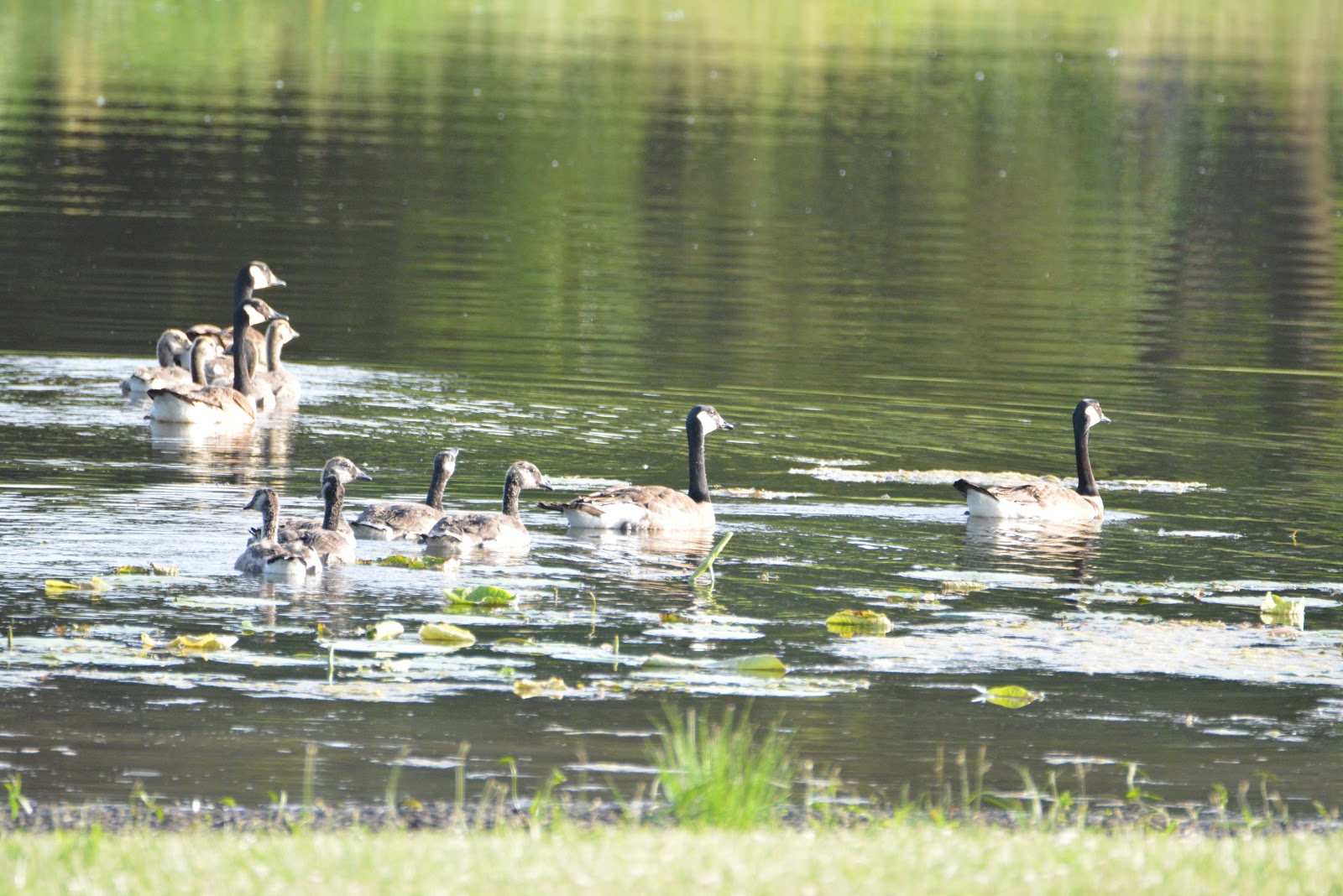

I leaned forward from my bench, because whatever scared them came from my 
left, or east side.  I never did see anything. 


It was not this guy... they see him all the time... I suspect a fox in the trees along the dam. 

I have had Nathan and Chris here for two days, up from 
Garnett... we go back in the morning, and then the 
dogs and cat and I will be back to our normal routine for 
a while! 


Friday, January 6, 2012

How Much Wood Can a Woodchuck Chuck?

Well, consensus seems to be that our dead varmint from last night was a woodchuck, aka groundhog.
Here are some interesting facts about them:

Woodchucks are stocky in appearance and often stand up on their hind legs, making them look tall. Their pelage varies greatly in color but ranges from gray to cinnamon to dark brown. Their body is covered with white-tipped guard hairs giving them a grizzled appearance. Their paws vary in color from a typical black to dark brown in most subspecies. However, one subspecies has paws that appear pink. Their short bushy tail is often black to dark brown and is 20 to 25% their total body length. They weigh from 2 to 6 kg, range from 415 to 675 mm in total length, and have tails that range from 100 to 160 mm in length. Although males and females are the same color, males are larger than females. Woodchucks have white teeth, which is uncharacteristic of rodents, and a dental formula of 1/1, 0/0, 2/1, 3/3, for a total of 22 teeth. They have rounded ears that can cover the external auditory canal which prevents dirt from entering the ear canal while burrowing. (Encyclopaedia Britannica and Inc., 2007; Forsyth, 1985; Grzimek, 2003; Kays and Wilson, 2002; Kwiencinski, 1998; Whitaker et al., 1998)
They live in burrows  that can reach 30 feet in length.  They are supposed to be hibernating during cold weather, and can slow their breathing down to do so.  Their burrows are characterized by a MOUND OF DIRT near the opening...


Hmmmmmm


  Preferred forage includes alfalfa (Medicago sativa), clover (Genus: Trifolium), and dandelion (Taraxacum officinale). Other foods include bark, leaves, insects, and bird eggs. All woodchucks store fat for winter hibernation. (Encyclopaedia Britannica and Inc., 2007; Forsyth, 1985; Grzimek, 2003; Kurta, 1995; Kwiencinski, 1998; Whitaker et al., 1998)

We saw many groundhogs in Leavenworth, they lived up and down our street, and drove Oscar nuts when they grazed in our front yard.  We just didn't see them quite so close up as this one. 

We have not seen any out here in 7 years, so are still mystified by this one found yesterday.  He is, by the way, thrown over the fenceline into a pasture to be carried away by the coyotes.  We are still puzzled as to why Lilly did not show any interest in it.


They're kind of cute. For a rodent.

(photo courtesy of National Geographic)


Woodchucks are active during the day, especially in early morning and late afternoon.